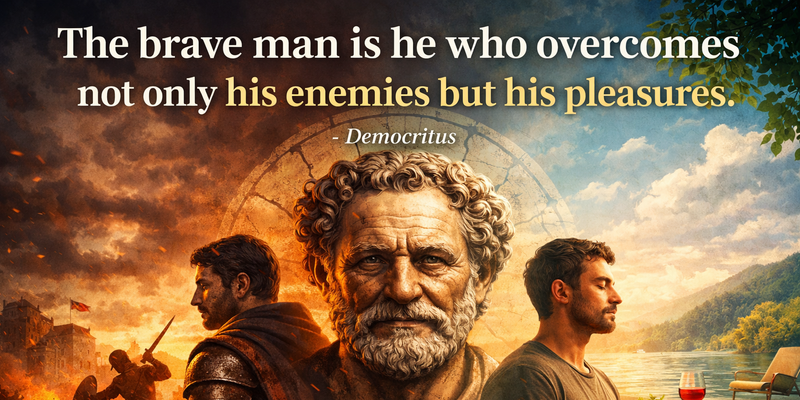
The brave man is he who overcomes not only his enemies but his pleasures
In a world that often equates bravery with visible acts of strength—winning battles, defeating rivals, or standing firm in the face of external threats—Democritus offers a quieter, more demanding definition. True courage, he suggests, lies not just in overcoming enemies, but in mastering one’s own pleasures.
At first glance, this idea feels counterintuitive. After all, pleasures are typically seen as rewards—harmless indulgences that bring comfort or joy. But Democritus challenges this assumption by pointing to a deeper truth: unchecked pleasure can be as powerful and destructive as any external adversary.
Enemies are visible. They exist outside us, making them easier to identify and confront. Whether it is competition in the workplace, conflict in relationships, or societal pressures, external challenges demand action, resilience, and strategy.
Pleasures, on the other hand, are internal and often disguised as harmless habits. Overindulgence in comfort, procrastination, excessive consumption, or even the constant need for validation can quietly erode discipline and clarity. Unlike enemies, pleasures do not attack—they invite. And that invitation can be far harder to resist.
In today’s context, this idea is more relevant than ever. The modern world is designed for instant gratification. From endless scrolling on social media to on-demand entertainment and convenience-driven lifestyles, distractions are abundant. The real challenge is not the lack of opportunity, but the ability to regulate how we respond to it.
Democritus’ quote shifts the definition of bravery from physical action to internal discipline. Overcoming pleasure requires awareness, restraint, and long-term thinking. It is the ability to say no when everything around you encourages yes.
This form of courage is subtle but powerful. It shows up in everyday decisions—choosing focus over distraction, consistency over comfort, and purpose over impulse. It is reflected in the student who studies instead of delaying, the entrepreneur who builds patiently instead of chasing shortcuts, and the professional who prioritises growth over immediate rewards.
Unlike defeating an external enemy, which may be a one-time victory, overcoming pleasure is an ongoing process. It demands continuous effort and self-reflection. There are no clear endpoints, only habits that are either strengthened or weakened over time.
It is important to note that Democritus is not advocating for the rejection of all pleasure. Rather, he is warning against becoming controlled by it. Pleasure, when moderated, can enrich life. It becomes problematic only when it dictates behaviour and decision-making.
The goal, therefore, is balance. Enjoyment should be intentional, not impulsive. Discipline should guide pleasure, not eliminate it. This balance allows individuals to experience fulfilment without losing direction.
In a culture that celebrates external success, Democritus reminds us that the most important victories are often invisible. The ability to control one’s desires, maintain focus, and act with intention is what ultimately shapes character.
Bravery, then, is not just about facing the world. It is about facing oneself.
And in that quiet, internal battle, the stakes are far higher—and the rewards far more lasting.