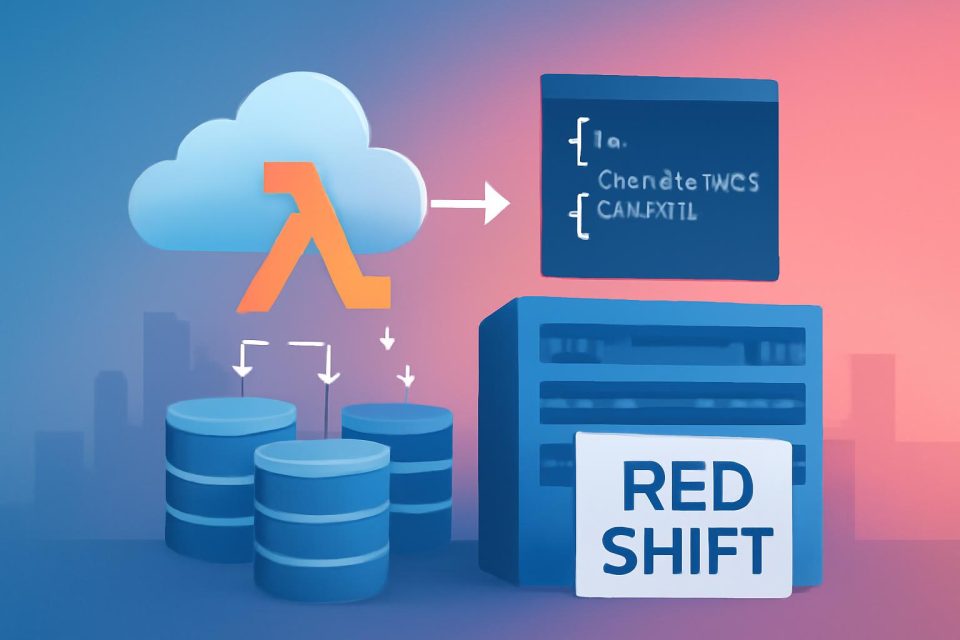
Lambda User-Defined Functions (UDFs) in Amazon Redshift can significantly enhance data processing capabilities. However, understanding best practices is crucial for optimizing performance and minimizing costs.
This article addresses key considerations such as selecting the right programming language, leveraging existing libraries, managing payload sizes, and implementing batch processing effectively. It also discusses scalability and concurrency management, providing insights on maximizing efficiency when using external services with Lambda UDFs.
Understanding Amazon Redshift and AWS Lambda
Amazon Redshift is a powerful cloud data warehouse solution that simplifies data analysis through standard SQL and business intelligence tools. AWS Lambda allows users to run code without the need for server management, supporting various programming languages and enabling automatic scaling.
Lambda UDFs enable direct execution of Lambda functions from SQL, facilitating integration with external APIs, improved code deployment, and enhanced compute scalability.
Prerequisites for Using Lambda UDFs
- Setup of an AWS account
- Basic knowledge of creating Lambda functions
- Access to an Amazon Redshift cluster with UDF permissions
Performance Optimization Strategies
Select Efficient Programming Languages
Choosing the right programming language can greatly influence both performance and costs. For example, benchmarks indicate that languages like Golang can outperform Python significantly, leading to reduced execution times and lower Lambda costs.
Utilize Existing Libraries
Leveraging libraries specific to the chosen programming language can enhance performance. For instance, using the Pandas library in Python can streamline dataset manipulation tasks.
Avoid Excessive Data in Payloads
Lambda imposes a payload size limit for synchronous invocations. Reducing unnecessary data in requests can enhance efficiency and minimize communication overhead.
Manage Return Data Size
Understanding the expected size of returned data is vital. If the return payload exceeds the Lambda limit, retries will occur, potentially causing delays. Setting a maximum batch size can help mitigate this issue.
Embrace Batch Processing
Batch processing can optimize UDF execution by allowing techniques such as memoization, which caches results to avoid redundant calculations.
Scalability and Concurrency Management
Increase Account-Level Concurrency
Redshift employs advanced congestion control, and Lambda has a default concurrency limit. Users can request increases in this limit to accommodate higher workloads.
Implement Reserved Concurrency
For teams requiring isolation in their Lambda functions, setting reserved concurrency can prevent their operations from impacting overall account performance.
Integrating External Services
Utilize External Services for Efficiency
In some scenarios, it may be beneficial to use existing external services instead of duplicating functionality within Lambda code. Services like Open Policy Agent for policy checks or Protegrity for data protection can enhance performance.
Conclusion
Implementing best practices for Lambda UDFs in Amazon Redshift can lead to significant improvements in performance and cost efficiency. Key takeaways include:
- Choosing efficient programming languages and tools
- Minimizing payload sizes and optimizing batch processing
- Managing scalability and concurrency effectively
- Integrating external services to enhance functionality
For further information, the Redshift documentation provides additional resources and examples.