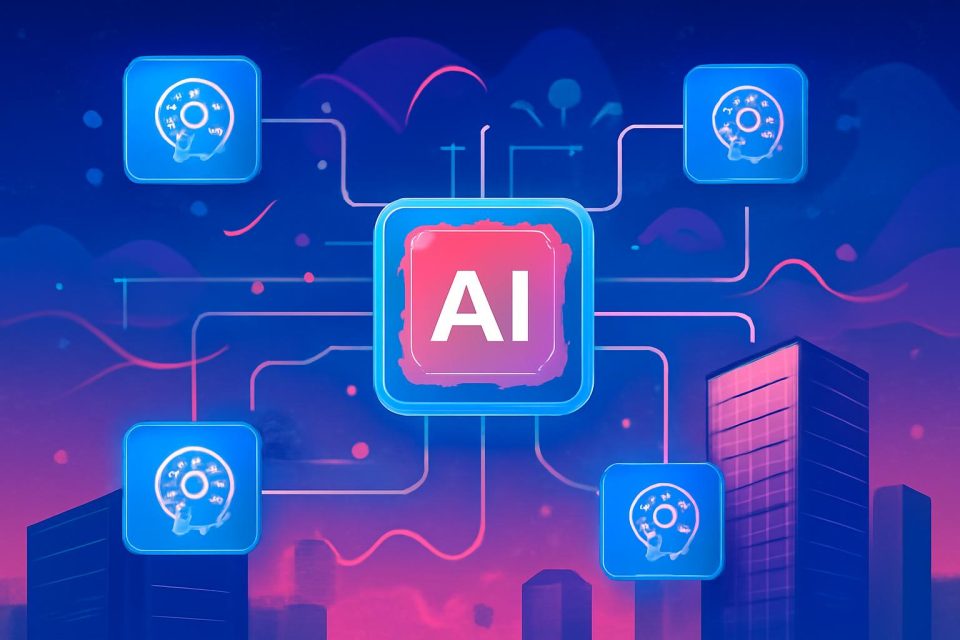
Building AI agents that function reliably in production environments can be challenging. The orchestrator pattern offers a solution that allows developers to integrate specialized AI microservices into existing applications without the need for extensive rewrites.
This approach focuses on creating a network of distributed agents rather than relying on a single monolithic agent. By doing so, developers can enhance the scalability and flexibility of their applications, making it easier to manage complex workflows.
Why Choose Distributed Agents?
Utilizing distributed agents allows for:
- Seamless integration: Frontend applications interact with a single orchestrator endpoint, simplifying the integration process.
- Independent scaling: Individual agents can be scaled according to their specific needs, optimizing resource usage.
- Modularity: Different components can be developed in various programming languages, communicating through standard protocols.
Implementing a Course Creator App
To illustrate the orchestrator pattern, consider a course creator application that consists of three main components:
- The Researcher: This agent specializes in gathering information.
- The Judge: This agent evaluates the quality of the research findings.
- The Orchestrator: This component coordinates the activities of the other agents and interacts with the frontend.
Step 1: Developing the Researcher
The researcher agent is designed to use Google Search for information retrieval, providing focused and relevant data without unnecessary complexity.
Step 2: Establishing the Judge
The judge agent ensures that the research meets quality standards. It provides structured feedback, enabling the application logic to make informed decisions.
Step 3: Utilizing the A2A Protocol
Agents communicate using the Agent-to-Agent (A2A) protocol, which standardizes interactions and facilitates information exchange over HTTP.
Step 4: The Role of the Orchestrator
The orchestrator acts as the central hub, managing the workflow and ensuring that the frontend remains clean and straightforward. It handles retries, state management, and communication between agents.
Deployment Considerations
Deploying this architecture on platforms like Cloud Run allows for efficient scaling. The system can adapt to varying loads without the need for extensive infrastructure changes.
Security and Reliability
While implementing distributed agents, it is crucial to consider security measures such as authentication and error handling to ensure robust performance in production environments.
Conclusion
By adopting the orchestrator pattern and utilizing distributed microservices, developers can create AI systems that are not only scalable and maintainable but also integrate smoothly with existing applications.