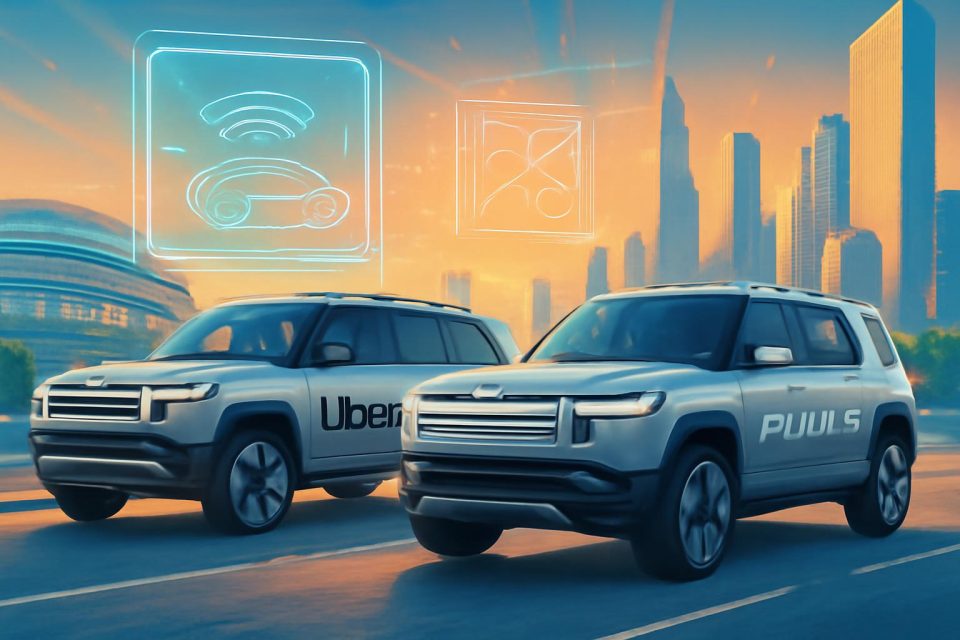
Uber has announced a significant investment of up to $1.25 billion in electric vehicle manufacturer Rivian. This partnership will enable the deployment of 10,000 autonomous Rivian R2 SUVs as robotaxis, beginning in 2028. The initiative aims to establish a fleet of driverless taxis in various cities across the United States, Canada, and Europe.
The investment will kick off with an initial $300 million, with further funding contingent on Rivian meeting specific autonomous vehicle milestones through 2031. This collaboration is crucial for Rivian, providing essential capital and a substantial commercial partner.
Investment Details
- Initial investment: $300 million
- Total potential investment: $1.25 billion
- Deployment of 10,000 R2 SUVs starting in 2028
- Funding contingent on meeting autonomous milestones
Market Implications
Rivian's shares experienced fluctuations following the announcement, reflecting investor sentiment about the company's future profitability. Analysts suggest that while Rivian has postponed its adjusted profit expectations to 2027, the partnership with Uber could help cover increased research and development costs.
Future Prospects
The R2 robotaxis will be exclusively available on Uber's platform, with initial operations planned for San Francisco and Miami. Uber also holds the option to purchase an additional 40,000 vehicles starting in 2030, contingent on the success of the initial deployment.
Industry Context
Interest in autonomous taxi services has surged recently, driven by advancements in technology and artificial intelligence. Rivian, known for its high-end R1S SUVs and R1T trucks, is preparing to launch its more affordable R2 models soon. Meanwhile, competitors like Waymo and Tesla are also expanding their robotaxi services, indicating a rapidly evolving market.
Conclusion
This partnership positions Uber as a central player in the robotaxi market, aligning with its strategy to collaborate with various autonomous vehicle operators. As the deployment of Rivian's R2 SUVs approaches, the industry will be watching closely to see how this investment shapes the future of driverless transportation.