Synopsis
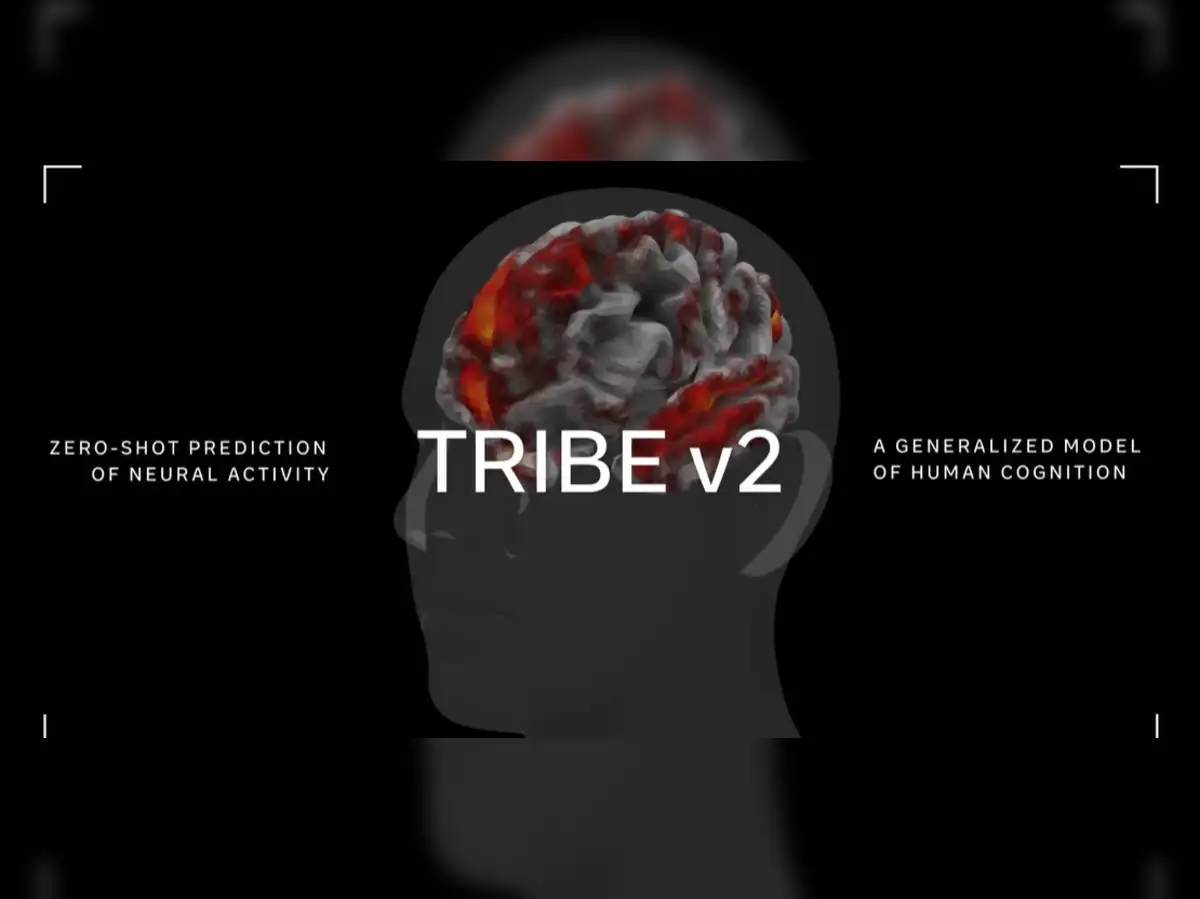
The Trimodal Brain Encoder (TRIBE v2) allows users to create a digital twin for neural activity. To build it, 700 volunteers were exposed to a wide range of media, including podcasts, films, images, and written text, while their brain activity was recorded using functional magnetic resonance imaging (fMRI). Per Meta, the model delivers a 70-fold increase in resolution over comparable systems, besides significant gains in speed and accuracy.Announcing the launch of foundation model TRIBE v2 (Trimodal Brain Encoder) on Thursday, the company said it will allow users to create a digital twin for neural activity.
The company has also released the model, its codebase, and a demo for researchers to accelerate breakthroughs in treating neurological disorders, the company said in a blog post.
TRIBE v2 features
The foundation model predicts brain activity utilising pretrained audio, video, and text embeddings.
Further, the company said, these interpretations are processed by a transformer for universal representation across all stimuli, tasks, and individuals.
To build it, Meta trained the system on brain imaging data from more than 700 volunteers, a dramatic expansion from earlier versions that relied on just a handful of subjects.
Participants were exposed to a wide range of media, including podcasts, films, images, and written text, while their brain activity was recorded using functional magnetic resonance imaging (fMRI).
fMRI is a technique that tracks blood flow in the brain as a proxy for neural activity. TRIBE v2 learns patterns from this data and predicts what a brain scan would look like without needing to run the scan itself.
Why it matters
The development builds on existing technology to study brain activity that requires expensive lab setups.
Meta said the new model delivers a 70-fold increase in resolution over comparable systems, alongside significant gains in speed and accuracy. That enables something researchers call “zero-shot prediction."
It is the ability to forecast brain responses for new individuals, new languages, and entirely distinct tasks without retraining the model.