Synopsis
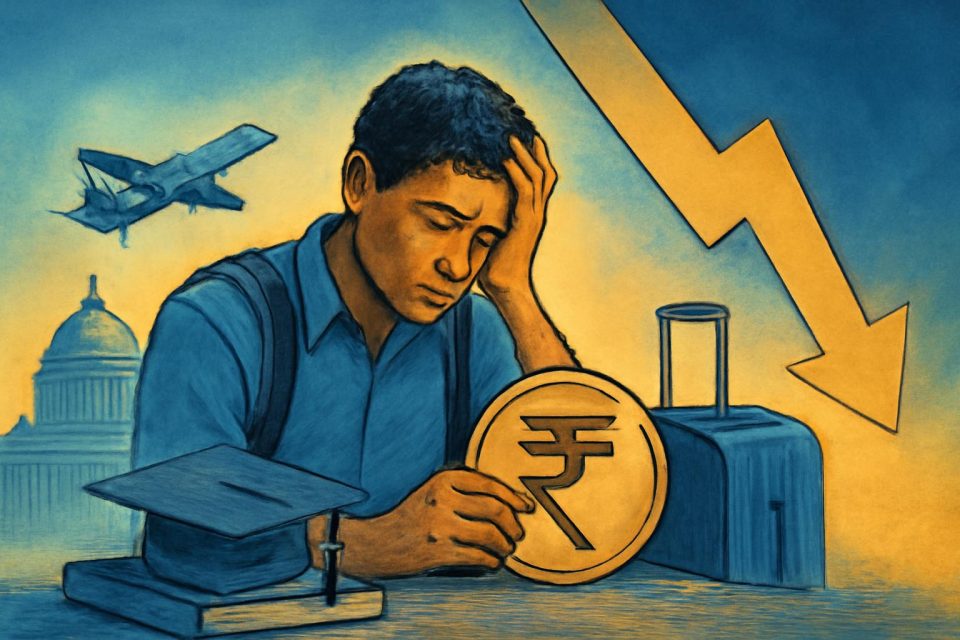
A significant rupee depreciation has forced Indian students studying abroad to seek top-up loans from lenders, as initial loan amounts fall short of rising tuition and living expenses. This has led to a nearly threefold increase in demand for additional funding, with students requiring Rs 1-6 lakh more.Listen to this article in summarized format
The funding gap has driven a nearly threefold jump in demand for top-up education loans from Indian lenders among students enrolled at US universities, industry executives told ET. Students are seeking top-ups of Rs 1-6 lakh, leading to enhanced sanctions, fresh documentation, power-of-attorney processes and disbursement delays, they said.
Mumbai-based entrepreneur Sunetra Banerjee, whose daughter is studying at a design university in the US, said she and her husband have paid at least Rs 7-8 lakh more than their initial estimates in the first year alone and are apprehensive about further cost escalation.
“Everything costs more…the course fees, living expenses, even the pocket money,” she said. “Travel costs have also jumped big time... A round-trip ticket that cost around Rs 96,000 a year ago, is now close to Rs 1.6 lakh.”
At the time of the initial loan disbursement, the rupee was trading at Rs 85 to the dollar. It is now at around Rs 95, Banerjee said, noting how quickly financial calculations can go awry.
Her daughter has now applied to her college for an additional scholarship. If that does not come through, Banerjee and her husband will have to either consider a top-up loan or liquidate some investments.
Banks and education-focused non-banking finance companies (NBFCs) in India sanction loans in rupees, while students pay university fees and living expenses in dollars, pounds or euros.
Mahesh Avasare, product lead at student lending platform MPower Financing, said the frequency of top-up loans for rupee borrowers has increased almost threefold in the past one year.
According to data from the Reserve Bank of India, around $450 million in outward remittances were made by Indians to fund overseas education programmes, including university fees and living expenses such as hostel costs, in March 2026. The RBI has not published comparable data for previous months.
The total outstanding education loan book of banks, including loans for domestic and overseas education, stood at Rs 1.55 lakh crore as of March 31, up 13.4% from a year earlier, according to RBI data.
Industry executives said a majority of this was linked to overseas education, with banks and NBFCs together disbursing around Rs 20,000-25,000 crore annually.
Banks and NBFCs have nearly equal shares of the market, with the State Bank of India, the country's largest lender, alone accounting for 20-25%, industry executives said.
When a loan is sanctioned, lenders convert the foreign-currency requirement into rupees at the prevailing exchange rate. However, if the rupee weakens sharply by the time a student draws the next tranche, the same foreign-currency requirement translates into a higher rupee amount, forcing lenders to process an enhanced sanction.
Large lenders typically build in some buffer for currency fluctuations, and secured loans can be enhanced more easily if collateral coverage remains adequate.
Growing burden
Chaitanya Kalipatnapu, cofounder and executive director of SoftBank-backed executive learning startup Eruditus, said the rupee's move from about 83 per dollar to over 96 in about one-and-a-half years has increased the cost of a four-year undergraduate degree in the US by Rs 30-35 lakh.
Getting a top-up loan may require fresh documentation for enhanced sanction. For students already overseas, this could mean a power of attorney executed abroad and sent to parents in India.
While higher funding requirements have not led to a blanket tightening of underwriting standards, top-up requests are being treated as enhanced loan sanctions. This means lenders must reassess the documented cost of education and living expenses, the borrower and co-borrower profile, repayment capacity and, in some cases, collateral before disbursing the additional amount.
Education-focused NBFCs said they are better placed to handle such cases because overseas education is their core business, while banks may take longer to process these requests.
All this is prompting some students to consider foreign university programmes delivered in India, where fees are paid in rupees and the overall cost can be 40-50% lower than studying abroad. “Instead of students going abroad…and getting impacted by currency depreciation, they could do the same school, similar quality programme based in India, to be paid in rupees,” Kalipatnapu of Eruditus told ET.
Rachit Agarwal, cofounder of study-abroad admissions platform AdmitKard, said currency depreciation has always been factored in conversations with families, but usually within a manageable range. “People know that currency will depreciate 2-5%. What has happened in recent times is that depreciation of 2-5% has moved to around 10%,” he said.
For many students, seeking additional top-up funding of Rs 1-2 lakh has led to operational delays in some cases, largely related to completing fresh paperwork, obtaining enhanced sanction approvals and ensuring that funds are available before the next fee payment or living-expense requirement falls due, Agarwal said.
Neeraj Saxena, managing director and chief executive officer of Auxilo Finserve, an education-focused NBFC, said some students, particularly those in the US, had earlier not fully drawn down their sanctioned loans because teaching assistantships, part-time work or family support helped cover a portion of their second-year expenses. That buffer is now getting exhausted.
“5-10% was always left and was not taken,” he said. “Now, maybe they will start taking that. The second perspective is that they may require a top-up.”
Alternate destinations
While the sharpest top-up pressure is emerging among students enrolled at US universities because of the scale of dollar-denominated tuition and living costs, executives said the rupee's decline is also changing affordability calculations for the UK, Europe, Australia and newer study-abroad destinations.
For study-abroad companies, the rupee's fall has become part of a broader affordability conversation.
Akshay Chaturvedi, founder and chief executive officer of Blume Ventures-backed Leverage Edu, said the top-end cohort attending expensive US universities remains largely insulated. The pressure is greater for the next cohort, where programme costs start at Rs 30-35 lakh. If that rises to Rs 35-40 lakh, it can materially alter the economics for families, he said.
Chaturvedi said the shift is opening up a wider set of destinations for Indian students, noting that many are increasingly considering destinations such as Hungary, Slovakia and Bulgaria, which are more affordable relative to traditional study-abroad markets.
Germany and Italy are also benefiting from the growing availability of English-taught programmes and scholarships, he said. Leverage Edu is placing students in the UK, Germany and Italy, with the UK its largest market and Germany its second-largest.