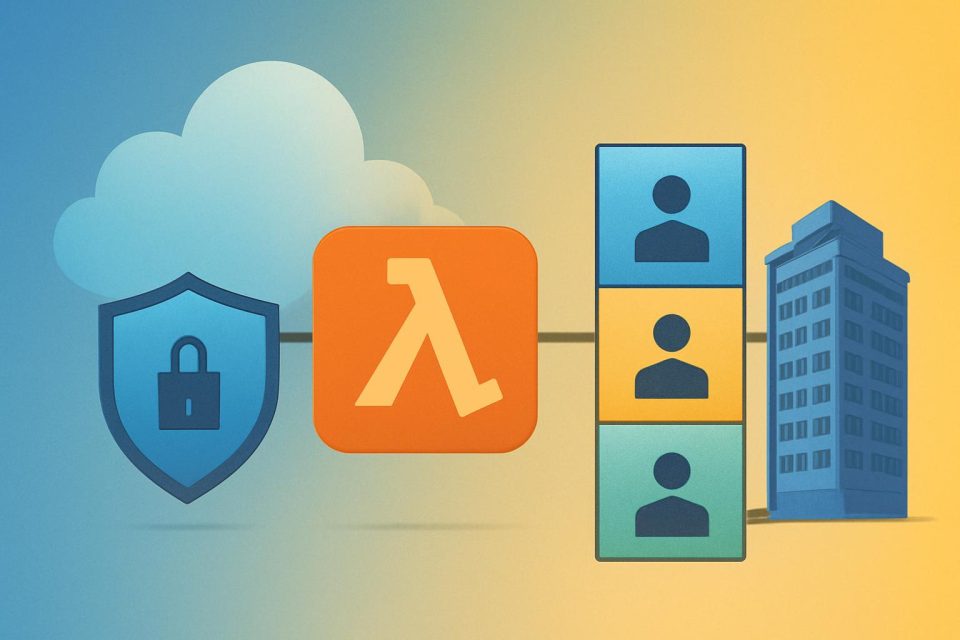
Developing multi-tenant SaaS applications often requires strict compute isolation to prevent data leakage and ensure security. Traditionally, developers faced a choice between sharing execution environments across tenants, which risks contamination, or managing separate Lambda functions for each tenant, leading to increased operational complexity and costs. AWS Lambda's tenant isolation mode with Event Source Mappings offers a solution that balances these challenges.
This innovative approach allows developers to maintain compute-level isolation while managing only a single Lambda function. By leveraging services like Amazon SQS and Amazon EventBridge, each tenant's workloads can run in dedicated execution environments, enhancing security and reducing operational overhead.
Key Features of Tenant Isolation Mode
Tenant isolation mode enhances Lambda's execution model by routing invocations based on tenant identifiers. Each execution environment is linked to a specific tenant, allowing for efficient reuse without compromising isolation. This means developers can cache tenant-specific configurations safely.
Implementing Tenant Isolation
To utilize tenant isolation mode, each invocation must include a tenant ID parameter. For synchronous calls, this is passed via the X-Amz-Tenant-Id header. Within the function handler, the tenant ID can be accessed using context.tenantId, enabling tenant-aware logic.
Handling Event Source Mappings
Many serverless applications rely on event-driven architectures where Lambda is triggered by Event Source Mappings (ESMs). However, these event sources do not automatically propagate the tenant ID as an HTTP header. To address this, a routing function can be introduced to extract the tenant ID from incoming events and invoke the tenant-isolated backend function with the appropriate context.
Routing Function Architecture
The routing function acts as a stateless dispatcher, ensuring that tenant isolation is maintained at the backend while allowing for shared event ingestion. This function processes incoming messages, extracts tenant IDs, and invokes the backend function using the Lambda Invoke API.
Considerations for Implementation
- Validate Tenant Identity: Always verify the tenant identity from event payloads to ensure security.
- Scaling: Be aware that tenant isolation mode may lead to increased cold starts due to separate execution environments for each tenant.
- Optimize Routing Function: Use asynchronous invocation to minimize waiting times and adjust function size accordingly.
- Understand Permission Boundaries: Consider fine-grained permissions for tenants if necessary.
Next Steps
Developers are encouraged to explore extending this pattern to other event sources like Kinesis Data Streams or DynamoDB Streams. Additionally, integrating AWS Step Functions can help orchestrate complex multi-tenant workflows while maintaining isolation.
A complete sample project demonstrating this pattern is available in the AWS samples repository, providing a practical foundation for building secure, scalable, event-driven multi-tenant SaaS applications on AWS.