Synopsis
They said 2026 marked the first year of grand-scale AI adoption in political management, the results of which will likely be visible in 2027 and beyond. “Everyone’s online, everyone has access to AI tools and if right now people are vibe coding $100 million companies, why can’t we be vibe coding political movements?” said Sudhanshu Kaushik, president and CEO of the Centre for Youth Policy.Listen to this article in summarized format
They said 2026 marked the first year of grand-scale AI adoption in political management, the results of which will likely be visible in 2027 and beyond. “Everyone’s online, everyone has access to AI tools and if right now people are vibe coding $100 million companies, why can’t we be vibe coding political movements?” said Sudhanshu Kaushik, president and CEO of the Centre for Youth Policy.
“We’ve been dealing with bot accounts since social media started and before that we had other ways of manufacturing movements. Even the origin of the Cockroach Janta Party is based on AI. The original website is also very AI slop. You’re going to have movements like this pop up all the time to reflect people’s identity issues.”
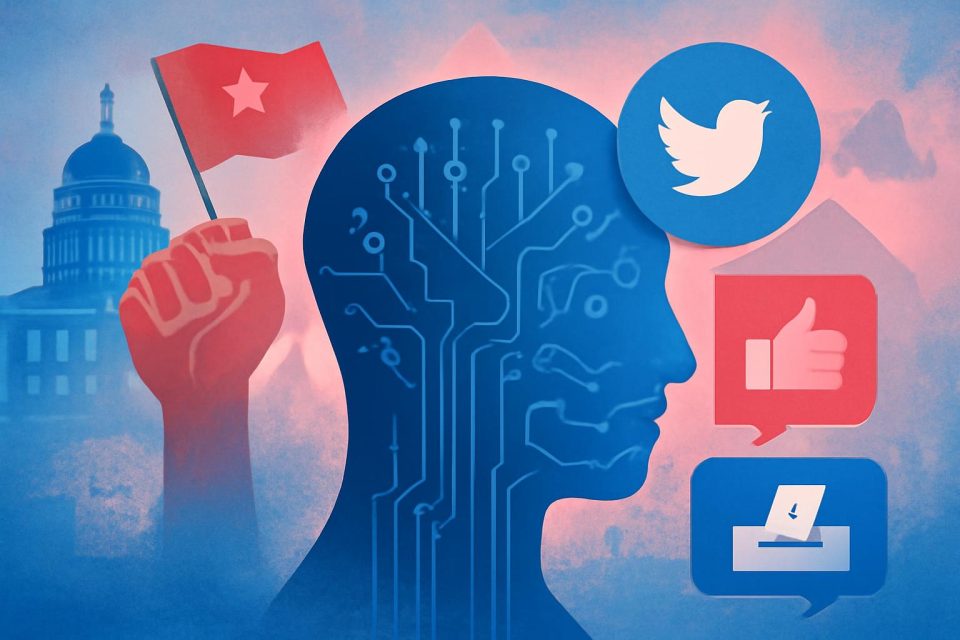
Experts said advanced AI agents can now act as “swarms,” autonomously adapting to human interaction to simulate authentic grassroots movements. While individual deepfakes rarely change voter minds, this technology drastically lowers the cost of manufacturing public consensus. By deploying hybrid networks of AI and real influencers, malicious actors can easily exploit platform algorithms, experts said.
“In general, AI-generated content today lowers the cost of building a politicallooking movement,” said Lukasz Olejnik, visiting senior research fellow at the department of war studies at King’s College London and author of Propaganda. “It can generate logos, slogans, videos, text content, audio content, including multilingual posts, synthetic personas, and tailored narratives. Everything moves at a pace and speed that previously required building with humans.”
He said the key analytical test is whether the campaign creates sentiment organically or merely reprocesses and accelerates existing sentiment. He added that bots will not disappear as they are necessary for distribution, engagement inflation, search manipulation and coordinated visibility but that they will increasingly be powered by AI agents.
“With AI tools being easily accessible, imitating authentic social dynamics will become easier,” said Lena-Maria Böswald, senior policy researcher at UK-based tech policy think tank Interface. “That raises the possibility of highly automated political movements. Right now, a malicious actor can launch a massive bot swarm cheaply to spread content widely. Agents are more advanced and autonomous: they can adapt in real time to engagement and human response across platforms. That’s a real game changer, as AI swarms could simulate public consensus in a much more sophisticated way.”
She said that astroturfing, or the idea of artificially creating a grassroots campaign, has always been an opaque strategic campaigning mechanism. But what’s new is the speed and scalability with which AI can produce and distribute content. “Compared with traditional bots, AI agents are harder to detect because they can generate context specific content targeted with precision,” she said.
“Looking for copy-pasting no longer works. A first step is looking for forensic indicators such as statistically unlikely coordination, account creation patterns and conspicuous engagement spikes.” However, Aishik Saha, a PhD candidate researching disinformation at the National and Kapodistrian University of Athens, Greece, said there are limits to how far such campaigns can succeed. “Research shows people usually are somewhat discerning of what they see online and can be very sceptical if it doesn’t align with their existing beliefs,” he said.
“The problem is mostly when it affirms existing beliefs of users, which polarises users on social media and ultimately harms democratic systems.” Bots or AI agents aren’t the only factor influencing the online information ecosystem. “Recommendation algorithms have a very important role to play in determining what people do or do not see on their newsfeed,” Saha said.
“While the use of LLMs in generating engagement can influence how users perceive particular events or narratives, social media platforms’ prioritisation of specific kinds of engagement can lead to widely varying results.” Olejnik said nations should be vigilant. “States may be cautious about whether such quickly developing movements are organic or if they bear the hallmark of a manufactured, covert influence operation using coordinated inauthentic behaviour, narrative laundering and synthetic grassroots amplification,” he said. “Some states, like Russia, are known for testing or conducting such influence activities.”