Organizations leveraging Amazon Aurora PostgreSQL for transactional workloads often face challenges in making operational data readily available for analytics. Traditional batch exports can introduce latency, and when data is spread across multiple Aurora clusters, joining datasets for cross-domain analytics becomes complex. Real-time change data capture (CDC) provides a solution by streaming row-level changes into a dedicated analytics layer, eliminating the need for downstream consumers to reconstruct the current state from change logs.
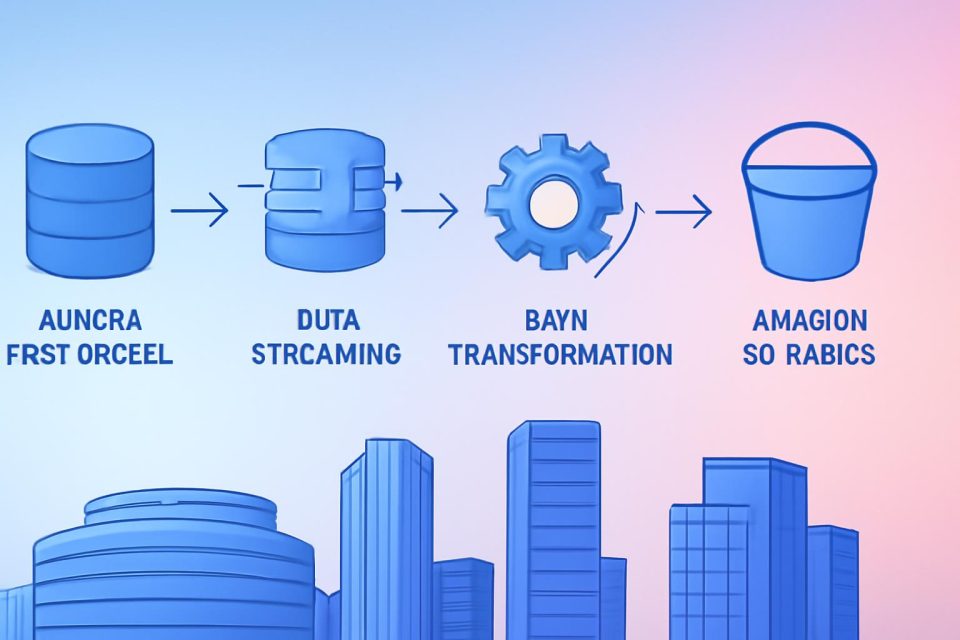
This article outlines the steps to build a CDC pipeline that delivers query-ready Iceberg tables directly from Aurora PostgreSQL to Amazon S3 Tables. The pipeline captures inserts, updates, and deletes, ensuring that the destination tables reflect the current state of the source database. Key components of this solution include Debezium for change capture, Amazon MSK for streaming, AWS Lambda for event transformation, and Amazon Data Firehose for delivering records into Iceberg tables, all deployed using the AWS Cloud Development Kit (AWS CDK).
Pipeline Architecture
The architecture consists of six main components:
- Amazon MSK for streaming CDC events.
- Debezium for capturing changes from Aurora PostgreSQL.
- AWS Lambda for transforming CDC events.
- Amazon Data Firehose for delivering records to Iceberg tables.
- Apache Iceberg for managing table snapshots and compaction.
- AWS Lake Formation for access control and permissions.
Debezium generates CDC events in an envelope structure, containing both the previous and current state of a row, along with metadata. Firehose, however, requires records in a flattened JSON format, necessitating a transformation step via Lambda.
Setting Up the Pipeline
To implement the CDC pipeline, the following prerequisites are necessary:
- Enable logical replication in Aurora PostgreSQL by configuring a custom DB cluster parameter group.
- Download and package the Debezium PostgreSQL connector, then upload it to Amazon S3.
- Register the connector with Amazon MSK Connect.
- Create a worker configuration for MSK Connect.
- Deploy the infrastructure using AWS CDK.
Once the infrastructure is set up, the Debezium connector will create a replication slot named debezium_slot. It is crucial to monitor the ReplicationSlotDiskUsage metric to prevent excessive storage usage on the Aurora cluster.
Data Flow and Transformation
As data changes occur in Aurora PostgreSQL, they trigger CDC events that flow through the pipeline:
- Changes are captured by Debezium and published to an MSK topic.
- Firehose streams the data to Lambda for transformation.
- Lambda processes the events and routes them to the appropriate Iceberg tables.
Each operation type (insert, update, delete) is handled appropriately, ensuring that the Iceberg tables in S3 reflect the current state of the source data.
Querying the Data
Once the data is in S3 Tables, it can be queried using Amazon Athena. The integration with the AWS Glue Data Catalog allows users to reference tables using the S3 Tables catalog format. Users can run queries to confirm that the data reflects the latest state after CDC operations.
Conclusion and Next Steps
This guide demonstrates how to create a near real-time CDC pipeline from Aurora PostgreSQL to Apache Iceberg tables in Amazon S3 Tables. By following the outlined steps, organizations can implement a robust solution for streaming operational data into a format suitable for analytics. For further exploration, users are encouraged to adapt this solution to their specific CDC workloads and consult the relevant AWS documentation for additional details.