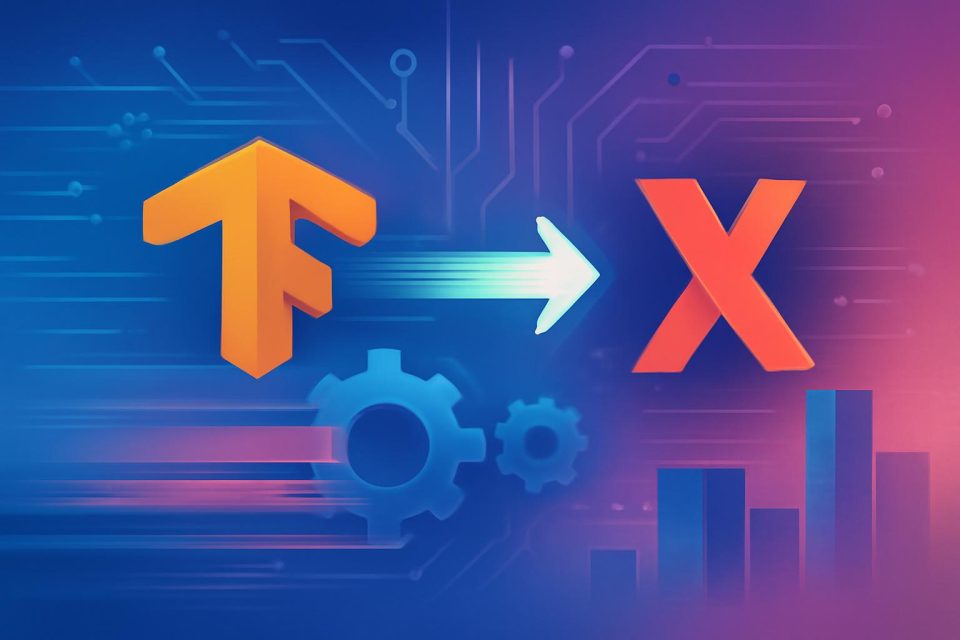
In the evolving landscape of software development, AI coding agents are becoming essential tools for enhancing productivity. Google has taken significant strides in utilizing AI for complex codebase migrations, particularly in transitioning from TensorFlow (TF) to JAX, a task that traditionally requires extensive manual effort.
Translating production-grade machine learning models involves more than simple syntax changes; it necessitates a comprehensive understanding of the code's structure and dependencies. Google's AI and Infrastructure team has introduced a multi-agent system that streamlines this process, achieving a remarkable sixfold increase in migration speed.
Transitioning to JAX
JAX is increasingly recognized as the future of scalable machine learning due to its optimization for modern hardware and its functional programming paradigm. However, migrating existing TensorFlow models to JAX presents substantial challenges, requiring a shift in how developers manage state and layer interactions. This migration process can consume hundreds or even thousands of engineering hours if done manually.
Innovative Multi-Agent Architecture
To tackle the complexities of large-scale migrations, Google developed a multi-agent architecture comprising:
- The Planner agent: This agent conducts static analysis to map the entire codebase's dependencies and formulates a step-by-step migration plan.
- The Orchestrator agent: Acting as a project manager, it organizes the migration tasks and ensures that necessary domain knowledge is applied throughout the process.
- The Coder agent: This agent is responsible for executing the migration, reading and writing code, running builds, and conducting tests in a self-correcting loop until a compilable component is achieved.
Validation and Playbooks
To ensure the quality of the migrated code, Google implemented a system of Playbooks that provide context-specific guidance tailored to various projects. These Playbooks help avoid common pitfalls and ensure adherence to coding standards. The system also includes rigorous verification metrics:
- Quantitative verification: Each unit of code is mathematically verified for correctness, ensuring functional equivalence between the original and migrated layers.
- Qualitative evaluation: A blind audit process assesses the migrated code against established architectural standards to capture critical logic.
Impact on Migration Efficiency
By employing this multi-agent system, Google has significantly enhanced the economics of software migration. Evaluations of complex models, such as those used by YouTube, demonstrated speed improvements of 6.4 to 8 times compared to manual migrations. Tasks that previously required months of engineering work can now be completed in weeks, allowing engineers to focus on innovation rather than translation.
Future of Software Migration
The integration of AI into large-scale migrations is poised to reshape how organizations adopt new technologies while maintaining system performance and security. Google's advancements illustrate the potential for automating complex engineering challenges through innovative methodologies.