Synopsis
H-1B visa registrations have seen a sharp decline this year. Stricter US immigration rules and increased costs are pushing companies to be more selective. The US Citizenship and Immigration Services reports a significant drop in registrations for FY27. This shift favors applicants with advanced degrees and higher salaries, signaling an end to mass, low-wage registrations.Listen to this article in summarized format
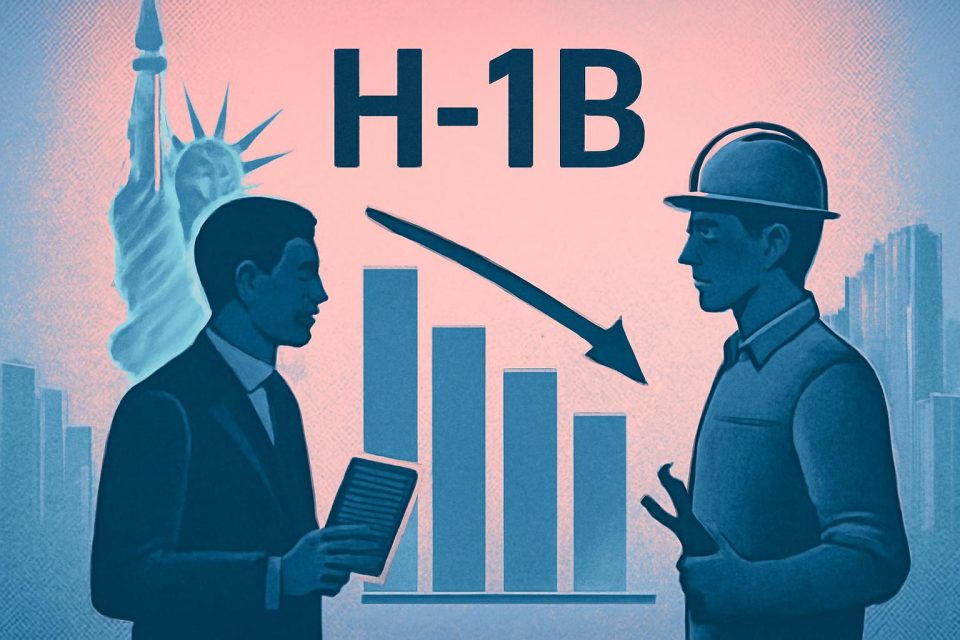
The US Citizenship and Immigration Services (USCIS), in an X post, said it received 211,600 eligible registrations for FY27, down from 343,981 last year.
The share of Indians in this pool is unclear. Indians accounted for 70% of the total H-1B approvals in FY25.
USCIS said it has been approving more applications with advanced degrees and higher salaries. “An overwhelming 71.5% of selected aliens hold a US master’s degree or higher, compared to 57% last year,” it said, adding about 17.7% of the applications were in the lowest wage category.
“This data is a clear sign that the days of abusing the program with mass, low-wage registrations are over, and that the program is better serving its intended purpose of attracting highly skilled foreign workers and protecting the wages, working conditions, and job opportunities of American workers,” the agency said in the X post.
The decline follows a series of changes in the skilled worker visa programme under the Donald Trump administration, including a $100,000 fee for fresh H-1B visas from September 2025 and a wage-based selection process that favours petitioners with higher wages and advanced degrees.
USCIS had opened registrations for the FY27 H-1B visa lottery for two weeks in March.
ET had earlier reported that immigration experts were seeing 30-50% decline in H-1B applications.
More students, L-1 employees
Many companies tweaked their H-1B filing strategies this year to avoid the high fee on fresh applications, immigration experts said.
Poorvi Chothani, immigration attorney and managing partner at LawQuest, said companies focused on registering students in the United States (on F-1 visas). Also, some employees on L-1B (intracompany transferee with specialised knowledge) were transferred to H-1B since it allowed them to file for green cards and avail of additional H-1B extensions at a later stage. “This number was not significant but there was a noticeable increase in these cases,” she said.
USCIS had clarified last year that the $100,000 fee will not apply to petitioners already in the US on a valid visa, be it F-1 or L-1.
Gnanamookan Senthurjothi, immigration attorney at The Visa Code, noted that FY27 saw a structural shift away from traditional entry-level hiring that included many bachelor's degree candidates to favouring advanced degree applications with higher wages. “This has forced many consulting and staffing firms to rethink recruitment strategies,” he said.
This is also coming at the time of declining entry level jobs in the US amid rapid artificial intelligence adoption, geopolitical uncertainty and slower business growth. According to a March report from the World Economic Forum citing data from Revelio Labs, entry level jobs in the US have fallen by 35% in part due to AI.
More Intentional
Shilpa Malik, managing attorney at VisaNation Law Group, said the H-1B lottery was no longer a numbers game.
“It is evolving into a narrow, high-stakes filter for senior and specialised talent,” she said. “For us, every case now demands a much deeper upfront analysis of wage positioning, role justification, and long-term strategy, which were conversations we would previously have had at the petition stage and happening before a single registration is filed.”
Joel Yanovich, senior attorney at Ganey Law Group, had earlier told ET that compared to previous years, when compensation was used by employers to verify a qualifying role, it now directly dictates their lottery odds. “The process has become significantly more cumbersome and costly,” he said.
In March, the US labour department proposed a rule to increase wages for H-1B workers by 20-30% across wage levels. While this is still in the proposal stage awaiting comments, these could further impact the applications, experts noted.
While these moves will reduce the number of applications, the US is still one of the favoured destinations for Indians. “But the scrutiny will increase for H-1B in terms of wage evaluation,” Senthurjothi of The Visa Code said.