Synopsis
Parents are increasingly choosing audio-only gadgets for their children, moving away from excessive screen time. Devices like Yoto and Tonies offer engaging content, helping kids focus and listen. This trend reflects growing concerns about the impact of screens on children's well-being. Companies are seeing significant revenue growth in this booming market.Listen to this article in summarized format
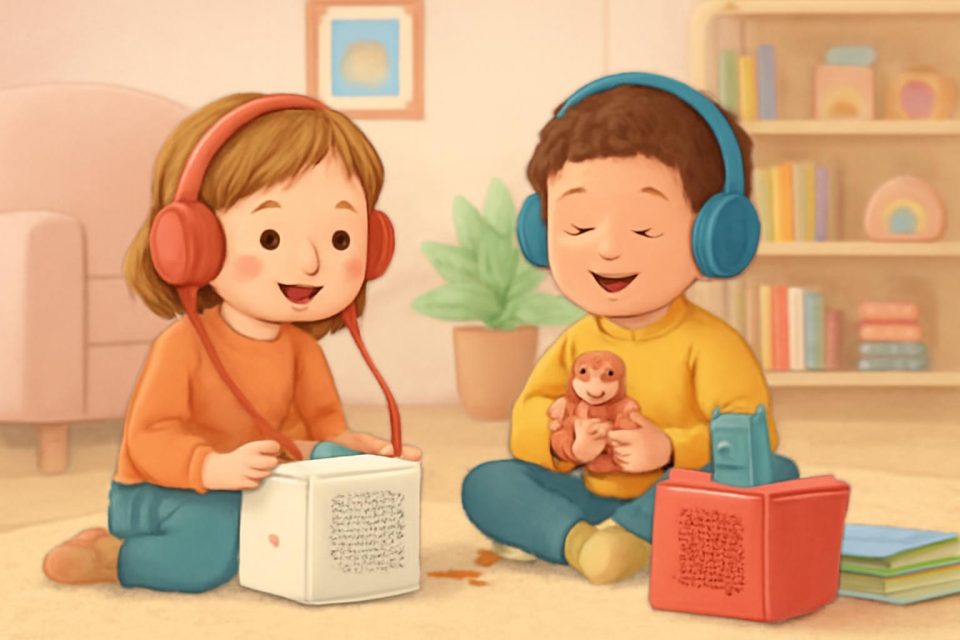
The tales and gags - many baffling to adult ears - are emitted by a Yoto player, one of a growing class of sound-only gadgets for young children.
Devices offering entertaining and educational audio content are increasingly sought out by parents keen to keep their offspring from overdosing on screens.
This comes at a time of increasing concern about the impact of electronic devices on children's mental and physical well-being.
"We try to avoid screen time. Of course, occasionally half an hour a day is fine but not more than that," said Emilia's mother Vanessa Gunnella, a 41-year-old economist living in Frankfurt, Germany.
Compared to when the young girl is dropped in front of a phone, iPad or television, "she gets more focused" when listening to programmes like Yoto's daily podcast, Gunnella said.
"It's good for her to focus and listen."
Guided streaming
Belief in the value of kids' audio is proving to be big business.
Germany-based market leader Tonies - Yoto's much larger commercial competitor - booked 630 million euros ($731 million) in revenue in 2025.
Last week, the company reported over 29% year-on-year revenue growth in the first quarter, to almost 126 million euros.
Privately-held Yoto is smaller, reporting 2024 revenue of just under 95 million pounds ($128 million) to the UK's Companies House.
Device makers are benefitting as "people are becoming very convinced that unlimited screen time is harmful", Tonies chief executive Tobias Wann told AFP.
In 10 years, Tonies has sold close to 12 million audio players and 150 million toy figures that kids can place on the box to unlock new content, he said.
Data shows children use their devices for almost 40 minutes a day, he added -- while insisting that the company's data collection is "never individualised" and only used to judge the popularity of different items.
Wann tied Tonies' success to a long-standing German culture of children's radio plays, known as Hoerspiele, that proved accessible when introduced to other global markets.
"Back in the day, I used to listen to those on long-playing records. Then came cassettes and CDs. And these days just about every child in Germany listens to Tonies figurines," he said.
With the popularisation of music streaming, the question at Tonies' founding was how to "give kids agency" safely, Wann said.
"You don't just want to give your child a smartphone or iPad and say, 'Here's Spotify. Good luck. Pick whatever you want.'"
Gunnella said that on a smart device, her daughter Emilia will often "change and skip and get some content which is not really good quality... I don't like that."
No silver bullet
Simply removing the screen from the equation is not a panacea, said child development expert Natalia Kucirkova, director of the International Centre for EdTech (educational technology) Impact and professor at Britain's Open University.
"By removing the screen, you are minimising that aspect or risk of this multi-sensory explosion" that young children can experience when using a device like a tablet or smartphone or even watching fast-paced modern cartoons, she said.
But "multi-sensory overload can also come without a screen", such as with toys sporting multiple flashing lights and sounds, Kucirkova added.
"It really depends on how (devices) are designed," she said.
What's more, children aged two to eight -- the core audience for products like the Toniebox or Yoto player -- are in the midst of learning both to produce and understand language and to interpret social cues and situations, Kucirkova noted.
"It's always preferable for this young age group to be using real-life humans" to practice social skills, she added.
Wann argued that as parents "we can't and don't want to spend the entire day with our children. It's not supposed to be that way either."
Many people caring for young children who have got in touch with him say the devices have benefitted them as well as their kids.
"I very often hear from parents that their kids will listen to the Toniebox for an hour when they wake up on Sunday morning and this one hour of extra sleep is priceless," Wann joked.
Kucirkova said that where kids do use gadgets, it used to be "primary guidance from researchers to say that if you want to use media, then use it with your child".
But not all parents had the possibility of doing this, she said, so researchers were now also looking at modifying the design of devices to help children use them in a healthier way.