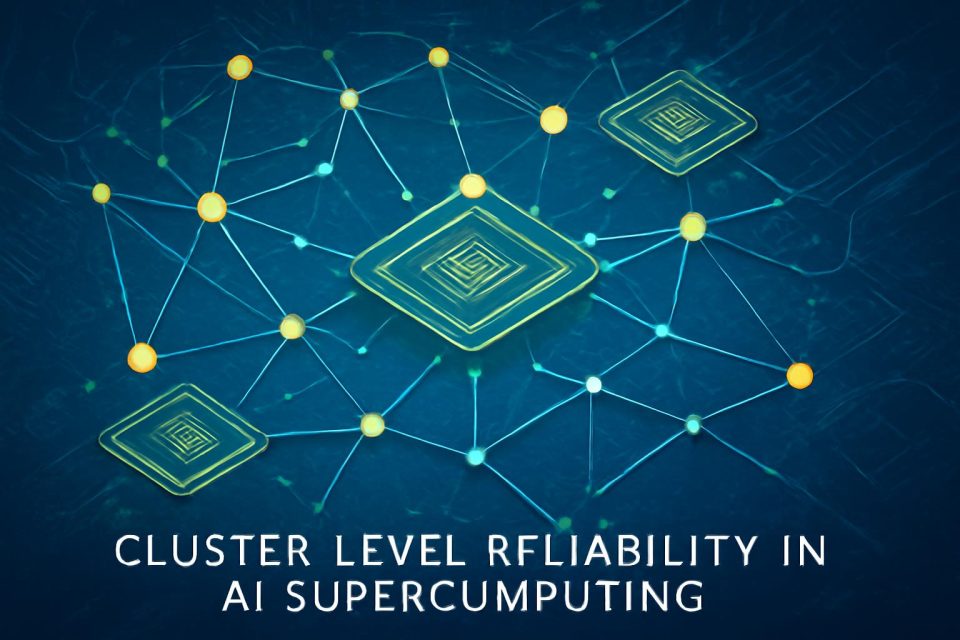
Google has unveiled a new cluster-level reliability framework for its Tensor Processing Units (TPUs), designed to meet the demands of frontier AI workloads. This shift from traditional instance-level reliability to a more robust cluster-level model aims to enhance the performance and availability of AI supercomputers.
As AI models grow in complexity, requiring trillions of parameters, the need for interconnected components operating as a cohesive unit becomes paramount. The previous standard of instance-level reliability, which treats infrastructure as a collection of independent units, falls short for large-scale AI applications.
Understanding TPU Superpods
TPU superpods are composed of thousands of chips organized into cubes, with high-speed Inter-Chip Interconnect (ICI) links ensuring seamless communication within and between the cubes. This architecture is crucial for maximizing training progress, as every chip must function optimally to contribute effectively.
Mathematical Insights on Availability
Reliability models at the instance level are often deterministic, but the complexity of industrial-scale AI requires a probabilistic approach. The new framework employs a binomial distribution to assess the health of the entire cluster, allowing for better predictions of operational capacity.
Performance of Ironwood Superpods
Using the Ironwood superpod as a case study, which consists of 9,216 chips, the model establishes that 130 out of 144 cubes can remain operational 95% of the time. This configuration supports significant compute workloads and ensures that the system is optimized for high-stakes training tasks.
Maximizing Resource Utilization
The cluster-level reliability model allows for full access to resources, even if some components fail. This ensures that researchers can still utilize the remaining capacity within a superpod for various workloads, including research experiments and inference tasks.
Enhancing Machine Learning Productivity
The new reliability standard is designed to improve goodput, a key metric for measuring machine learning productivity. By ensuring that resources are available and operational, the model supports high scheduling goodput, allowing for efficient large-scale training runs.
Future of AI Infrastructure
This cluster-level reliability framework represents a significant advancement in the reliability of AI supercomputers. By aligning infrastructure capabilities with the needs of cutting-edge AI research, Google aims to facilitate faster and more reliable AI breakthroughs.